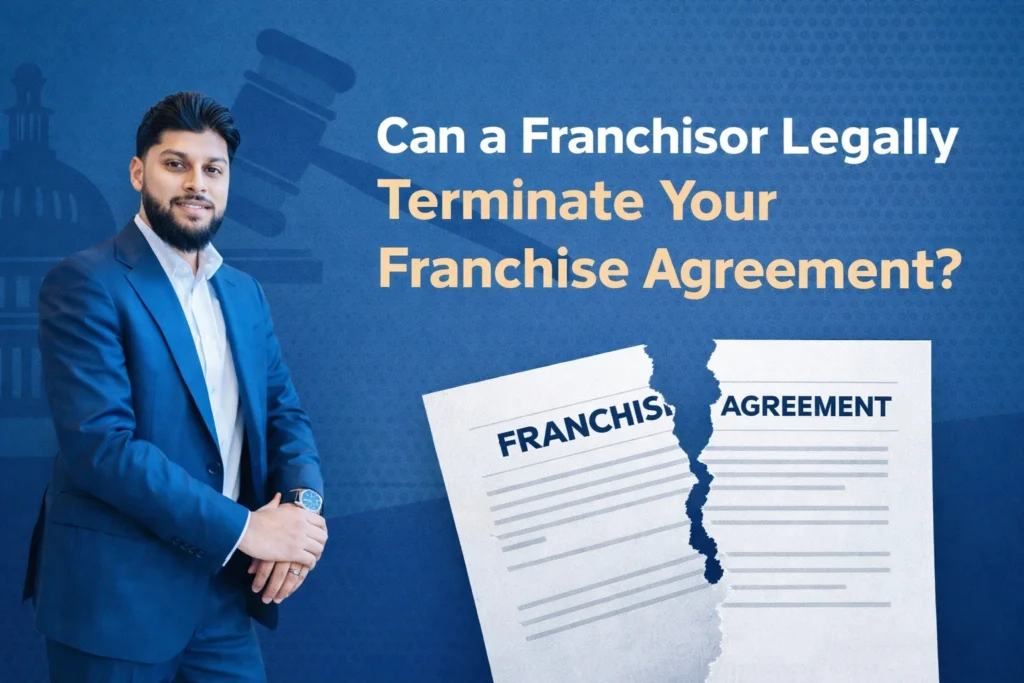
Receiving a termination notice from your franchisor can feel overwhelming. You have invested significant money, time, and effort into building your business. Many Ontario franchisees worry whether their franchisor can simply end the agreement at any time. The answer is no. Ontario law places clear limits on when and how a franchisor can legally terminate a franchise agreement. This guide explains the rules, your protections, and exactly what actions you should take to safeguard your rights and investment.
Here’s what this guide will help you understand:
- The specific legal grounds a franchisor needs to end your agreement
- The required notice and cure process under Ontario law
- How the duty of good faith works in your favor
- Immediate practical steps if you receive a termination notice
- How Ontario rules differ from those in the United States
Understanding Termination Under Ontario Law – The Arthur Wishart Act
Ontario law provides franchisees with important safeguards that limit a franchisor’s ability to end agreements arbitrarily.
The Arthur Wishart Act is the key law governing franchises in Ontario. It requires both franchisors and franchisees to act with fairness and honesty. This law applies to the entire relationship, including any attempt to terminate the agreement. Franchisors must follow proper procedures and cannot act for improper reasons. This creates a much more balanced environment compared to many other places.
What Counts as a Material Breach That Allows Termination?
Serious violations of the agreement can give a franchisor grounds to end the relationship.
A material breach occurs when a franchisee commits a significant failure that strikes at the core of the franchise system. Examples include ongoing failure to pay royalties, repeated violations of brand standards that harm the reputation, or unapproved changes to the business. Small or isolated issues usually do not qualify as material. Courts look at the actual impact and whether the breach can be fixed.
How Much Notice and Cure Period Must a Franchisor Give?
Franchisors cannot end agreements suddenly without giving you a chance to respond.
They must first issue a formal notice of default that clearly explains the problem. They are also required to provide a cure period. This is a set amount of time, often between 14 and 60 days, during which you can correct the issue. If you fix the problem within this window, termination can be avoided in most cases.
How Does the Duty of Good Faith Protect You?

Fair dealing is a fundamental requirement in every franchise relationship in Ontario.
The duty of good faith means the franchisor must act honestly and reasonably toward you. They cannot use termination as a way to punish you for legitimate complaints or to replace you with someone who will pay higher fees. This protection gives you strong grounds to challenge any unfair actions.
What Is Wrongful Termination and What Remedies Do You Have?
If a franchisor ignores the rules, their actions may be considered invalid.
Wrongful termination happens when proper notice is not given, the cure period is too short, or the decision violates good faith principles. In such cases, you may seek damages for lost profits, an order to stop the termination, or other court remedies. Successful claims can also include recovery of legal costs.
Step-by-Step: What to Do the Day You Receive a Termination Notice in Ontario
Fast and smart action can greatly improve your position.
Follow these steps right away:
- Read the entire notice carefully and note all deadlines.
- Collect every document related to your franchise agreement and communications.
- Avoid making any written admissions without professional advice.
- Contact an experienced franchise lawyer the same day.
- Keep detailed records of all new communications.
- Review whether franchise rescission might apply due to disclosure problems.
- Prepare your response within the allowed time.
- Consider your options for negotiation or dispute resolution.
If you received a termination notice and need help reviewing it quickly, a free 15-minute consultation is available to assess your situation.
After Termination: Your Post-Termination Obligations and Risks
The end of the agreement does not remove all responsibilities.
Post-termination obligations typically include removing all branding within a specific timeframe, making final payments, returning confidential materials, and following any non-compete rules. Ontario courts carefully review non-compete clauses to ensure they are reasonable. Understanding these obligations early helps you minimize financial losses and plan your next steps.
Ontario vs. United States – Key Differences at a Glance
Location matters when it comes to franchise protections.
| Aspect | Ontario | United States |
| Good faith duty | Required by law | Often depends on the contract |
| Cure period | Usually required | Varies greatly by state |
| Rescission rights | Strong statutory rights | Limited in many states |
| Court approach | Focus on fairness | More contract-focused |
This comparison shows why many franchisees in Ontario have stronger legal standing.
Choose Our Franchise Law Services for Unmatched Quality and Trust
When facing a serious franchise issue, you need a lawyer who understands both the law and the real challenges of running a location.
Flat-fee pricing means you always know the cost in advance with no surprises. The principal lawyer holds dual qualifications in Canada and the United States and has personally helped open more than 70 franchise locations across the Greater Toronto Area. Practical advice comes from real experience rather than theory alone. Subscription plans give ongoing access to legal support at predictable monthly rates. Service covers franchisees throughout Toronto, Mississauga, Burlington, and the entire GTA through convenient virtual consultations. Call (647) 965-0516 to discuss your situation.
Frequently Asked Questions
Can a franchisor take away your franchise?
Yes, but only when specific legal grounds exist and proper procedures are followed.
When Can a Franchisor Terminate a Franchise Agreement?
Termination is allowed only for valid material breaches after notice and opportunity to fix the issue.
Can a franchisor terminate a franchise agreement without cause?
No. Arbitrary termination usually violates the duty of good faith.
What are the legal grounds for termination of a franchise agreement?
The most common grounds involve serious and ongoing failures to meet key obligations in the agreement.
What happens if a franchisor terminates your franchise agreement?
You must complete certain post-termination tasks while retaining the right to challenge any unfair process.
Can I sue my franchisor for wrongful termination?
Yes. Ontario law provides several possible remedies depending on the circumstances.
What should I do immediately if I receive a termination notice in Ontario?
Stay calm, document everything, and seek professional legal advice without delay.
How does the Arthur Wishart Act protect franchisees from unfair termination?
It requires fair dealing and good faith in all aspects of the relationship.
Are non-compete clauses still enforceable after franchise termination in Ontario?
They are enforceable only if they are reasonable in time, geography, and scope.
How can flat-fee or subscription legal support help during a franchise termination dispute?
It gives you cost certainty and quick access to expert guidance when you need it most.
Conclusion
Ontario franchisees have meaningful legal protections against unfair termination. Understanding the Arthur Wishart Act, material breach requirements, notice rules, and your immediate options puts you in a much stronger position. Do not face a termination situation alone.
Call (647) 965-0516 today for a free consultation. Whether you need a quick review of your notice or full support through a dispute, help is available to protect your business and your future.