
Buying multiple franchise units in Canada triggers legal obligations that do not exist in a single-unit deal. A multi-unit buyer must review a layered set of agreements, confirm provincial disclosure compliance, assess territory rights across each location, and decide on a corporate structure, often all at once and under deadline pressure.
Multi-unit franchise acquisition Canada law sits at the cross-section of provincial franchise statutes, corporate law, commercial leasing, and contract negotiation. Getting any one of these wrong can cost you a territory, expose you to undisclosed liabilities, or leave you personally on the hook for obligations you never intended to assume.
Cloudhaus Law has helped structure and close over 100 franchise locations across the GTA for clients including Popeyes Louisiana Kitchen, Strong Pilates, Chaiiwala, and Eh to Zed. This guide covers what you need to review, what the law requires, and where the most common legal risks appear in multi-unit transactions.
By the end of this article, you will know:
- How multi-unit acquisitions differ legally from buying a single franchise unit
- What the Arthur Wishart Act requires in Ontario for multi-unit transactions
- What to review in a multi-unit development agreement before signing
- How territory rights work and where encroachment risk appears
- What financial documents to request and how to structure your acquisition entity
How Does a Multi-Unit Franchise Acquisition Differ Legally from Buying One Unit?
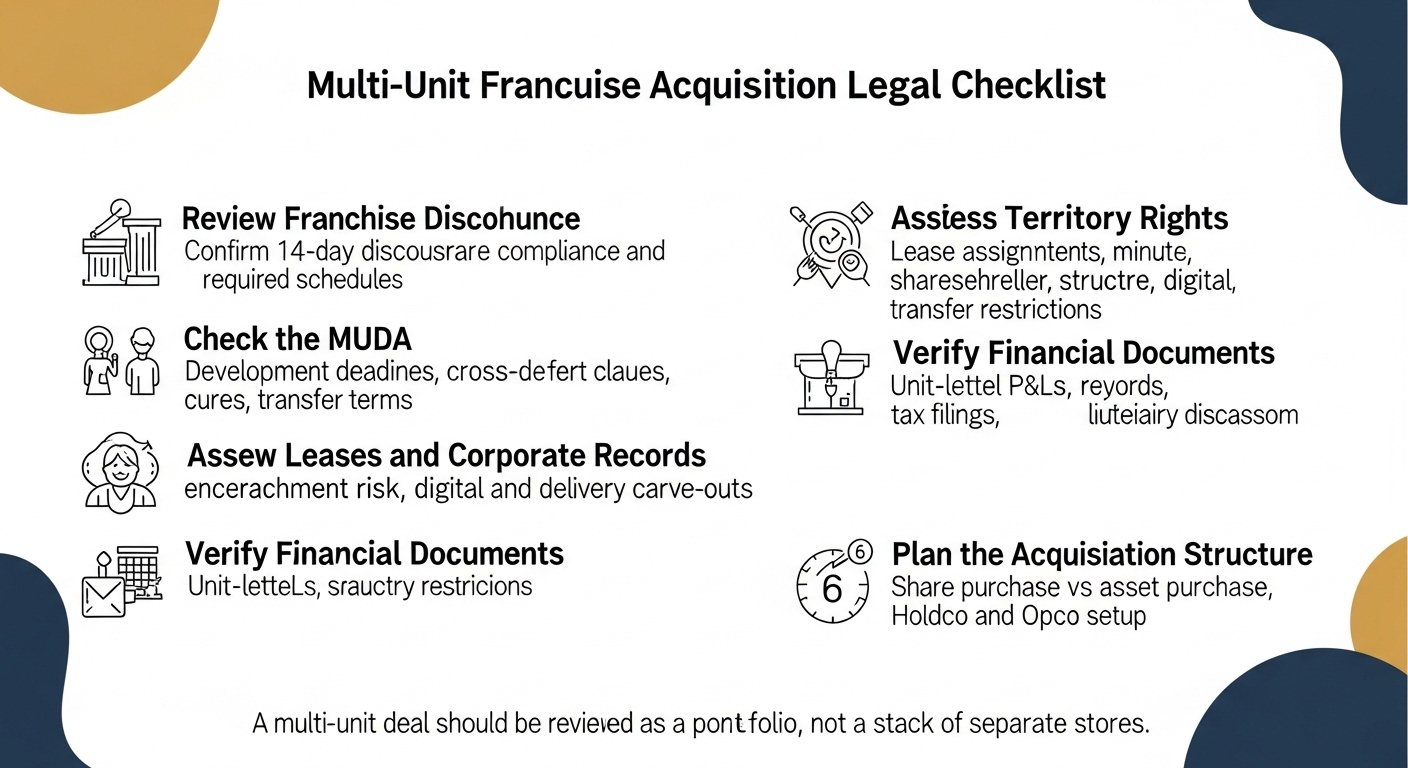
A single-unit purchase involves one Franchise Disclosure Document (FDD), one franchise agreement, and one lease. A multi-unit acquisition multiplies every one of those workstreams and adds agreement layers that simply do not exist in a single-unit deal.
The most significant addition is the multi-unit development agreement (MUDA). This agreement governs the timeline and conditions under which you must open each location. It sits above the individual franchise agreements and carries its own default provisions, development deadlines, and termination rights. Missing a development date, even briefly, can give the franchisor grounds to cancel your right to future units, including territories you have already paid to reserve.
Deal structure also changes in a multi-unit context. In a single-unit resale, buyers almost always purchase assets. Where the seller operates through a corporation, there is often a real case for a share purchase instead. A share purchase preserves existing lease assignments and supplier relationships, but it also means you inherit the seller’s liabilities, including any CRA obligations, pending claims, or undisclosed disputes. That is why representations and warranties clauses and holdback or escrow arrangements carry more weight in multi-unit transactions.
We recently worked with a buyer acquiring four QSR locations from a departing franchisee. The seller had structured the business through a holding company, and the asset purchase structure initially proposed would have required re-executing four separate lease assignments, each of which required landlord consent. Switching to a share purchase structure with proper indemnification provisions saved weeks of delay and reduced third-party consent risk across the portfolio.
What Does the Arthur Wishart Act Require in a Multi-Unit Transaction?
The Arthur Wishart Act (Franchise Disclosure), 2000 applies to all franchise transactions operating partly or wholly in Ontario. In a multi-unit deal, its requirements create obligations many buyers underestimate.
Under Section 5, the franchisor must provide a compliant FDD at least 14 days before the buyer signs any agreement or pays any money toward the franchise. This statutory disclosure period cannot be waived by contract. In a resale scenario, whether a fresh FDD is required depends on whether the transaction is treated as a new grant or a transfer. Buyers should never assume a resale qualifies as a simple transfer without legal confirmation.
If the FDD is materially deficient or missing required schedules, Section 6 of the Act gives the franchisee the right of rescission:
- A deficient FDD triggers a 60-day rescission window from the date it was received
- If no FDD was provided at all, that window extends to two years from the date of signing
Two additional protections apply throughout the transaction and post-closing:
- Section 3, Duty of Fair Dealing: Both parties must act in good faith and in line with reasonable commercial standards.
- Section 4, Right of Association: Franchisees cannot be penalized for organizing with other franchisees in the same system.
For buyers acquiring units in Alberta, British Columbia, Manitoba, New Brunswick, or Prince Edward Island, equivalent franchise disclosure statutes apply with their own timelines. VERIFY provincial-specific timelines before proceeding.
Reference: Arthur Wishart Act (Franchise Disclosure), 2000, Ontario e-Laws
What Should You Review in a Multi-Unit Development Agreement Before Signing?
The MUDA is often the most consequential document in the transaction and the one that receives the least attention. Buyers focus on individual franchise agreements because those feel familiar. The MUDA, however, governs the broader relationship and frequently contains the most restrictive terms.
Development Schedule and Deadlines
Review how many units must open, by what dates, and whether those dates are fixed or tied to franchisor approvals such as site selection or lease execution. If the franchisor delays an approval, confirm whether you still face a default for missing the date.
Default and Termination Provisions
Check what triggers a default and how much cure time you receive. The most important clause to scrutinize is the cross-default clause, a provision that links all your units to the performance of any single one. If Unit 3 falls behind on royalties, a broadly drafted cross-default clause can allow the franchisor to assert default across your entire portfolio simultaneously. Also confirm whether the franchisor can terminate the MUDA and retain development fees already paid.
Transfer and Exit Terms
Confirm whether you can sell individual units separately or must sell the entire portfolio together. Understand the transfer fee structure per unit and whether franchisor consent requirements apply to partial sales. One client came to us after signing a MUDA with a cross-default clause and no per-unit cure period. When one location hit a temporary cash flow issue, the franchisor used it to flag all five units at once. Negotiating that clause before signing would have protected the full portfolio.
How Do Territory Rights Work Across Multiple Units?
A protected territory in a franchise agreement typically prevents another franchisee from operating within your defined area. It does not automatically prevent the franchisor from operating company-owned locations, alternative formats, or digital sales channels in that same territory.
In a multi-unit acquisition, territory risk compounds because you are managing several defined areas at once. Assess these risks during due diligence:
- Territory encroachment: Review the FDD and request a current map of all existing and planned locations. Check whether any competing outlets, operated by the franchisor or nearby franchisees, draw from your units.
- Digital and delivery carve-outs: Many post-pandemic franchise agreements reserve online ordering, ghost kitchen, or third-party delivery rights for the franchisor. These carve-outs are frequently buried in schedule definitions.
- Renewal modifications: Some agreements allow the franchisor to revise territory boundaries at renewal. If any units are approaching renewal, confirm what modification rights exist and whether any notices have already been issued.
- Internal overlap: In food service and retail, two nearby units within your own portfolio can generate internal competition if territory boundaries are not clearly drawn between them. Map each unit’s territory before closing.
Reference: Competition Act (Canada). Territorial exclusivity in franchise systems is generally permissible, but market allocation provisions between franchisees in the same system may attract regulatory scrutiny.
What Financial Documents Should You Request During Due Diligence?
Financial and legal due diligence overlap directly in a multi-unit acquisition. What you request has implications for representations and warranties, purchase price adjustments, and entity structuring.
For each existing unit, request the following:
| Document | Why It Matters Legally |
|---|---|
| Unit-level P&L statements (3–5 years) | Validates FDD Item 19 financial performance representations |
| Royalty and marketing fund payment records | Confirms no outstanding amounts owing to the franchisor at closing |
| Full lease with all amendments | Exposes personal guarantees, assignment restrictions, and renewal terms |
| CRA tax returns and correspondence | Identifies tax liens or assessments that survive a share purchase |
| Corporate minute books | Required for share purchase; confirms corporate authority to sell |
| FDD Item 3, litigation disclosure | Identifies pending claims that may carry forward after closing |
FDD Item 19 sets out the financial performance representations the franchisor is permitted to make. These figures reflect the system-wide disclosure, not each individual unit’s actual performance. Always reconcile Item 19 data against the specific unit’s P&L before closing. A gap between the two is a direct legal and commercial concern that should be addressed in representations and warranties.
For financing, both the Business Development Bank of Canada (BDC) and the Canada Small Business Financing Program (CSBFP) are common funding sources for multi-unit buyers. Both lenders require a clean legal and financial due diligence package as part of the lending process.
Cloudhaus Law in Richmond Hill offers free initial consultations for multi-unit franchise buyers across Ontario and Canada. Reach out before signing anything at cloudhauslaw.com or call (647) 965-0516.
Do You Need a Holding Company Structure When Acquiring Multiple Units in Ontario?
Yes, in most cases. Acquiring multiple units through a single operating company creates unnecessary exposure. A liability in one unit, such as a negligence claim, an employment standards dispute, or a CRA reassessment, can reach assets across your entire portfolio without a proper structure.
The standard approach for multi-unit operators in Ontario is a holding company that owns separate operating companies, with each operating entity running one or more units. This structure:
- Shields profits accumulated in the holdco from claims arising in the operating entities
- Supports use of the Lifetime Capital Gains Exemption (LCGE) on eligible shares at the time of sale VERIFY current LCGE thresholds with your accountant
- Separates liability between units in a default or insolvency scenario
- Creates cleaner exit mechanics if you want to sell individual units rather than the full portfolio
Whether to incorporate under the Ontario Business Corporations Act (OBCA) or the Canada Business Corporations Act (CBCA) depends on your growth plans and whether you anticipate operating across multiple provinces. This decision should be made before the letter of intent is signed.
Why Cloudhaus Law for Multi-Unit Franchise Acquisitions
Cloudhaus Law, led by dual-licensed Canada and U.S. lawyer Irbaz Wahab, works exclusively in Business Law, Franchise Law, Restaurant Law, and MSB Law. That focus means you get a lawyer who understands franchise deal mechanics, not a generalist working through your file for the first time.
Proven franchise track record: Over 100 franchise locations opened and structured across the GTA, with clients including Popeyes Louisiana Kitchen, Strong Pilates, Chaiiwala, and Eh to Zed.
Real deal experience: Irbaz began his career negotiating multi-million dollar contracts for the City of Toronto. That background directly informs how we approach MUDA negotiations, territory disputes, and purchase agreement drafting.
Dual Canada and U.S. bar admission: Cross-border acquisitions involving U.S. franchisors are handled in-house, with no need to coordinate between two firms.
Flat-fee pricing: No hourly billing. You know your legal budget before work begins.
Fully virtual delivery: Consultations, document reviews, and e-signing are handled remotely, from anywhere in Canada.
Free initial consultation: Get direct legal input on your acquisition before committing to anything.
Frequently Asked Questions
What is a multi-unit franchise acquisition and how does it differ legally from a single unit?
It involves buying two or more franchise units through a new MUDA or a resale of an existing operator’s portfolio. Legally, it differs because you are reviewing layered agreements, making a share-vs-asset purchase decision, managing multiple lease obligations, and meeting provincial disclosure requirements across all units at the same time.
What does the Arthur Wishart Act require in a multi-unit Ontario transaction?
The franchisor must deliver a compliant FDD at least 14 days before you sign or pay anything. A deficient FDD gives you 60 days to rescind. No FDD at all extends that right to two years from signing. The duty of fair dealing and right of association apply throughout and after closing.
What should I focus on in a multi-unit development agreement?
Prioritize cross-default clauses, development deadlines, cure periods, territory exclusivity, and franchisor consent requirements for transfers. Cross-default clauses, which link all units to the performance of any single one, are the highest-risk provision in most MUDAs.
How do territory rights work in a multi-unit acquisition?
A protected territory stops other franchisees from opening nearby, but it rarely stops the franchisor’s own digital channels or alternative format locations. Review each unit’s territory on a map, check for delivery or online carve-outs, and confirm no renewal-based territory modifications have been flagged in the FDD.
Can a franchisor refuse to consent to a multi-unit transfer?
Yes, on legitimate grounds like financial qualifications or brand fit. Under Section 3 of the Arthur Wishart Act, consent cannot be withheld arbitrarily or used to impose commercially unreasonable conditions. A refusal that breaches the duty of fair dealing may support a damages claim.
Get Your Multi-Unit Acquisition Reviewed Before You Sign
Missing a disclosure obligation, signing a MUDA with a broad cross-default clause, or skipping a holding company structure are the most common legal mistakes multi-unit buyers make, and all of them are avoidable with the right review before you commit.
Cloudhaus Law Professional Corporation serves multi-unit franchise buyers across Toronto, Mississauga, Richmond Hill, North York, Burlington, Scarborough, and nationally across Canada. Call (647) 965-0516, email irbazwahab@cloudhauslaw.com, or book a free consultation at cloudhauslaw.com.